
It is a more interesting read on rare earth elements history during a week with chaos news elsewhere.
Though as buzz word for a while, what exactly rare earth are is not that definitive, magnet is just one of the downstream use of them.
To some extent, MOFCOM dual use list have provided a knowledge bank on this – as it encompass ore, compound, metal, and downstream product like ferrous alloy and magnets, with all reference HS codes listed.
Country trade profile also provides a level of fact of how this value chain look like and industrial policy impact.
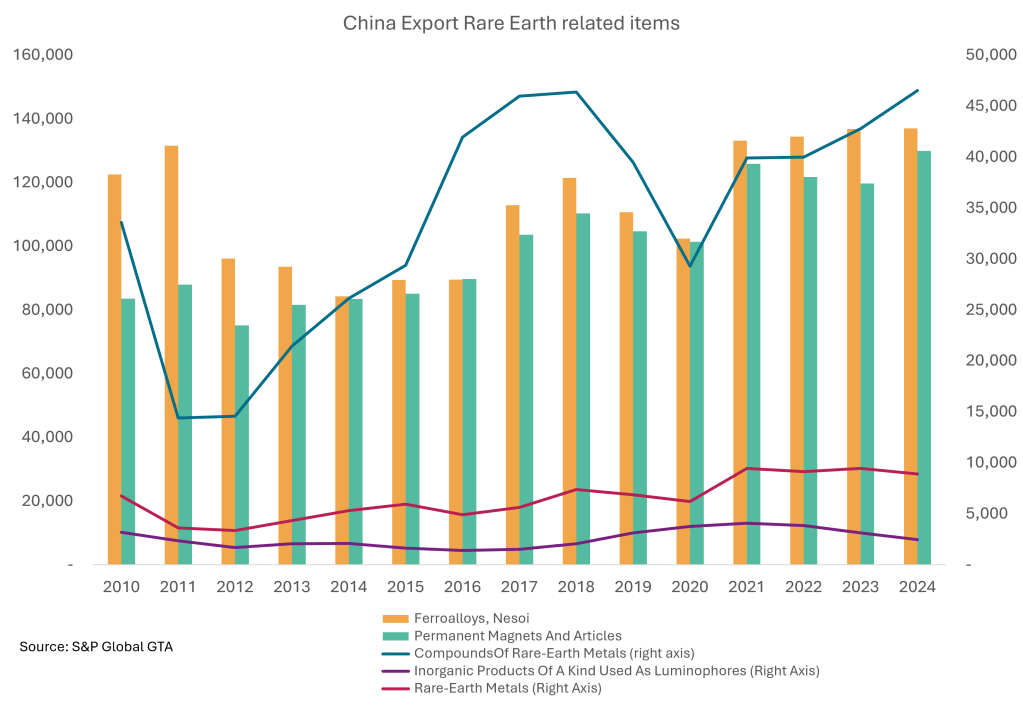
China’s export of rare earth related items are now more featured in compound and down-stream use (although not the end use), compared to decades ago when export is more focused on raw material. Permanent magnet is now one of the key output (and the most frequent subject of export control evasion as captured by China Customs; probably that’s why President Trump called “they have to give us magnets”); while Malaysia – also having its strategy on rare earth up/mid/down stream, has less export raw material since 2021 but yet to ramp up on downstream. Australia features in more resource-intense reflecting in its export (especially since Lynas started production in MA back 2012)- although the produce is more of Lanthanides family. As earlier said it’s not only about where the ore is, but about refining, purity and scalability, and also, the application of them. A modern technology version of “clay to fine bone china”.
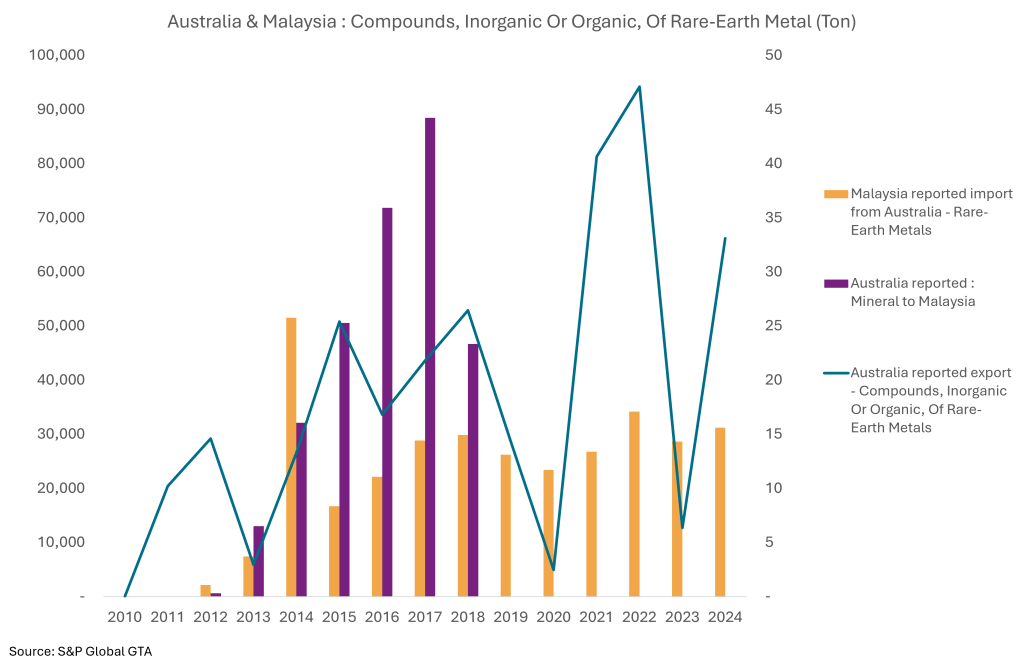
What is also noticeable is the AUS – MA bi-lateral trade asymmetry. While Australia reports most of the export are of mineral and compounds; Malaysia’s import shows they are all ‘rare earth metals’ – potentially a result of non-mutual quality inspection recognition. And that reminds the 3M Customs agenda (appendix-8—customs-strategic-framework-on-building-connectivity—3m-plus-3s-initiative.pdf) that has been on table for years, and CN-MA exchange digital Certificate of Origin from Jan 2026 Malaysia, China Begin Electronic Exchange Of Trade Certificates From Jan 2026 – and probably to achieve a really effective border management, collaboration is the better way, rather than the other.

 YanBreeze 言泊理滋